 English
 Italian
 Spanish
 Turkish
 Portuguese
 Dutch
Dutch Korean
 Russian
 French
 German
 Polish
 Arabic
 Hindi
HindiWhat Makes a Digital Signage Manufacturer Reliable for Long-Term Projects?
Digital displays have become part of everyday business operations rather than optional marketing equipment. Retail chains rely on them to deliver consistent promotions across hundreds of locations. Hotels use them to improve guest communication. Hospitals display real-time information for patients and visitors. Schools, transportation hubs, government buildings, and corporate offices all depend on commercial displays to communicate information efficiently.
As digital signage projects become larger and more integrated, purchasing decisions have also become more complex. Procurement teams are no longer evaluating a single display—they are investing in an entire system that may remain in operation for five to ten years. Hardware performance, software compatibility, maintenance requirements, product consistency, and future scalability all influence the total cost of ownership.
This explains why many projects encounter difficulties even after successful installation. Screens may perform well during initial testing but become unreliable after continuous operation. Spare parts may be difficult to source. Software updates may stop after only a few years. Different production batches may not match in brightness or color, making future expansion difficult. These issues rarely appear on specification sheets, yet they have a significant impact on long-term project performance.
For that reason, selecting a digital signage manufacturer involves far more than comparing screen size, brightness, or processor specifications. A dependable manufacturing partner contributes engineering experience, stable production capability, quality management, software support, and customization resources that continue to create value long after the displays have been installed.
This article examines the factors that distinguish a reliable manufacturer from a supplier that simply assembles display products, while also looking at how evolving commercial display requirements are reshaping purchasing decisions across multiple industries.
Why Display Specifications Tell Only Part of the Story
Commercial display projects often begin with a technical comparison. Procurement teams collect quotations, compare display parameters, and shortlist suppliers according to visible specifications.
Typical comparison items include:
· Screen resolution
· Display size
· Brightness level
· Operating system
· Processor
· Memory capacity
· Storage capacity
· Touch technology
· Connectivity options
These specifications certainly matter, but they rarely determine whether a project remains successful after several years of operation.
Consider two digital signage systems that appear almost identical on paper. Both offer 4K resolution, Android operating systems, capacitive touch technology, and similar processors. Six months after installation, one network continues operating smoothly while the other begins experiencing system freezes, inconsistent color performance, delayed software updates, and increasing maintenance costs.
The difference usually originates behind the product rather than inside the product.
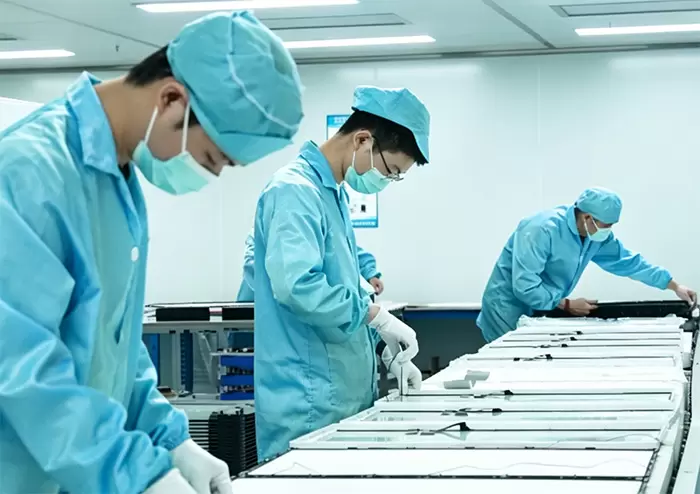
A reliable commercial display manufacturer invests heavily in areas that customers rarely see during quotation comparisons.
These include:
· Hardware validation before mass production.
· Long-duration reliability testing.
· Thermal management optimization.
· Stable motherboard design.
· Consistent component sourcing.
· Software compatibility testing.
· Production quality inspection.
· After-sales engineering support.
These investments increase manufacturing costs, but they significantly reduce operational risks throughout the product lifecycle.
For organizations deploying hundreds of displays across multiple cities or countries, stability becomes far more valuable than marginal improvements in processor speed or memory capacity.
Procurement managers increasingly evaluate suppliers according to lifecycle value instead of initial purchase price.
Questions often include:
· How many years will replacement components remain available?
· Can software continue receiving updates?
· Will future production batches match existing installations?
· How quickly can technical problems be resolved?
· Does the supplier maintain its own engineering team?
These considerations directly affect operating costs, maintenance efficiency, and customer satisfaction.
Why Different Industries Require Different Digital Signage Solutions
The phrase commercial digital signage covers an enormous range of applications. Two displays may appear similar externally while serving completely different operational requirements.
Understanding these differences helps explain why experienced manufacturers typically develop multiple product platforms instead of one universal solution.
Industry | Primary Requirement | Key Considerations |
Retail | Product promotion | High brightness, remote content management |
Restaurant | Digital menu boards | Long operating hours, easy updates |
Hotel | Guest communication | Elegant design, multilingual content |
Healthcare | Information guidance | Continuous reliability, readable displays |
Education | Campus communication | Interactive functions, scheduling integration |
Government | Public information | Stability, security, long service life |
Transportation | Passenger information | High brightness, weather resistance |
Shopping malls | Advertising | Large-format displays, flexible layouts |
Corporate offices | Internal communication | Meeting integration, collaboration support |
A retailer may prioritize promotional flexibility, while a hospital focuses on uninterrupted operation throughout the day. Educational institutions often require interactive capabilities, whereas transportation facilities demand displays capable of operating under challenging environmental conditions.
These differences also influence display design.
For example:
Retail environments often benefit from:
· Slim cabinet design.
· Android content management.
· High visual impact.
· Frequent content updates.
Healthcare facilities generally require:
· Reliable long-term operation.
· Clear readability.
· Low maintenance frequency.
· Consistent image quality.
Corporate environments increasingly prefer:
· Interactive collaboration.
· Wireless presentation.
· Video conferencing compatibility.
· Flexible installation options.
This diversity has encouraged many manufacturers to expand beyond traditional advertising displays.
Today, a comprehensive display solution provider may offer:
· Android digital signage
· Interactive displays
· Touch screen kiosks
· Information kiosks
· Self-service terminals
· LCD video walls
· Conference displays
· Commercial touch displays
Rather than selling individual products, experienced suppliers provide complete display ecosystems that support different business scenarios.
Why Engineering Capability Has Become a Competitive Advantage
Commercial display technology evolves continuously.
Display panels improve.
Processors become more powerful.
Operating systems receive regular updates.
AI functions are becoming increasingly common.
What remains difficult to replicate is engineering experience.
Reliable digital signage manufacturers generally control much more than final assembly.
Engineering teams may participate throughout product development, including:
· Mechanical structure design.
· Motherboard integration.
· Heat dissipation analysis.
· Wireless communication testing.
· Touch calibration.
· Power management optimization.
· Software validation.
· Aging tests before shipment.
Each stage contributes to product stability.
Heat management provides a useful example.
Commercial displays often operate between 12 and 24 hours every day. Poor thermal design gradually affects processor performance, LCD lifespan, touch accuracy, and overall reliability.
While these issues may not appear during factory inspection, they often emerge after thousands of operating hours.
Experienced manufacturers therefore conduct accelerated aging tests that simulate years of continuous operation before products enter mass production.
Software development has also become an essential engineering capability.
Many organizations now expect features such as:
· Remote device management.
· Cloud-based monitoring.
· OTA software updates.
· Device grouping.
· Content scheduling.
· User permission management.
· System diagnostics.
These functions require dedicated software development rather than simple hardware assembly.
As digital signage networks continue expanding, software stability becomes just as important as display performance.
What OEM and ODM Services Mean for Modern Display Brands
Many companies selling commercial displays no longer manufacture products themselves.
Instead, they cooperate with an experienced OEM smart display or ODM smart display partner capable of transforming product concepts into market-ready solutions.
Although the terms are frequently used together, they describe different business models.
Service Model | Manufacturer Responsibility | Brand Responsibility |
OEM | Produces according to customer specifications | Branding, sales, market strategy |
ODM | Designs and manufactures complete products | Branding and distribution |
Custom Development | Joint engineering collaboration | Product planning and market positioning |
OEM projects generally suit companies with established product specifications and technical teams.
ODM projects are attractive for businesses seeking faster market entry while reducing research and development investment.
Demand for custom smart display solutions continues to grow because businesses increasingly target specialized applications instead of general-purpose markets.
Examples include:
· Healthcare information systems.
· Smart classroom displays.
· Retail advertising networks.
· Restaurant ordering terminals.
· Corporate collaboration displays.
· Self-service check-in kiosks.
· Smart city communication systems.
Each application introduces different hardware and software requirements.
Customization may involve:
· Screen size.
· Housing materials.
· Camera configuration.
· NFC integration.
· Barcode scanning.
· Printer modules.
· Android version.
· Memory configuration.
· Brand identity.
· Packaging.
This flexibility allows distributors and private-label brands to differentiate themselves without investing in their own manufacturing facilities.
For manufacturers, OEM and ODM capabilities have evolved from optional services into essential competitive advantages.
What Problems Usually Appear After Installation?
Many commercial display projects perform well during acceptance testing. The screens are bright, the content plays smoothly, and every function appears to meet the project requirements. Problems often emerge several months later, after the displays begin operating every day in real business environments.
This is where the difference between a product supplier and an experienced digital signage manufacturer becomes much more apparent.
Unlike consumer electronics, commercial digital signage is expected to operate for extended periods, often 16 to 24 hours a day. Displays installed in shopping malls, transportation hubs, hospitals, or restaurants rarely have the opportunity to "rest." Continuous operation places significant demands on every component inside the device.
Several issues are commonly reported during long-term operation.
· Brightness gradually becomes inconsistent between displays installed in the same project.
· LCD panels develop noticeable color differences after prolonged use.
· Internal cooling systems struggle in high-temperature environments.
· Touch accuracy begins to drift after thousands of user interactions.
· Android systems become slower because of poor software optimization.
· Network communication becomes unstable after repeated firmware updates.
· Spare parts become difficult to source because production has already changed to a newer platform.
· Different production batches cannot be mixed because cabinet dimensions or display colors are no longer consistent.
Many of these problems are not caused by poor components alone. More often, they result from insufficient engineering validation before mass production.
For example, an LCD panel may fully satisfy the required brightness specification. However, if heat generated by the power board is not effectively dissipated, the display temperature rises during continuous operation. Elevated temperatures gradually reduce panel lifespan, accelerate component aging, and increase the likelihood of image retention or unexpected failures.
The same principle applies to software.
A display running Android may perform well immediately after installation. Without long-term software maintenance, security updates, application compatibility, and remote management functions eventually become outdated. Organizations managing hundreds of displays cannot afford to manually troubleshoot every device whenever software problems occur.
Reliable manufacturers therefore invest in long-term software maintenance as carefully as they invest in hardware engineering.
This approach significantly lowers maintenance costs over the product lifecycle.
Why Software Has Become Just as Important as Hardware
Several years ago, purchasing decisions focused almost entirely on hardware specifications.
Today, software determines much of the user experience.
A modern android digital signage platform is expected to do much more than display videos or images.
Businesses increasingly require centralized control over hundreds or even thousands of displays located in different cities or countries.
Typical software functions include:
· Remote content publishing.
· Real-time device monitoring.
· User permission management.
· Emergency message broadcasting.
· Automatic scheduling.
· Multi-screen synchronization.
· OTA firmware updates.
· Device health monitoring.
Without stable software architecture, even premium hardware becomes difficult to manage.
This is particularly important for industries such as retail.
A nationwide retail chain may update promotional content every week. Manual updates are no longer practical.
Restaurants frequently adjust seasonal menus.
Hotels modify conference schedules daily.
Hospitals display changing department information.
Transportation facilities publish real-time passenger announcements.
Every one of these applications depends on software reliability rather than screen resolution.
When evaluating a digital signage supplier, procurement teams increasingly ask software-related questions.
For example:
· Is the content management platform developed in-house or provided by a third party?
· How often are firmware updates released?
· Can software functions be customized?
· Does the system support remote diagnostics?
· Is API integration available for existing enterprise systems?
· Can devices be managed in different geographic regions from one platform?
These questions rarely appeared five years ago.
Today, they often influence purchasing decisions as much as hardware performance.
Questions Procurement Teams Should Ask Before Selecting a Manufacturer
Many purchasing departments compare quotations from three or four suppliers before making a decision.
Price remains important.
Experience shows that the lowest quotation does not always produce the lowest project cost over several years of operation.
Instead of concentrating only on product specifications, procurement teams benefit from understanding the manufacturer's long-term capabilities.
Useful questions include:
· Does the manufacturer operate its own production facility?
· How large is the engineering and R&D team?
· How long has the company been producing commercial display products?
· Are quality inspections conducted throughout production or only before shipment?
· Which international certifications are available?
· How frequently are software platforms updated?
· Can hardware configurations be customized?
· Does the manufacturer provide OEM and ODM development?
· Is long-term spare parts support available?
· What industries has the manufacturer previously served?
Another useful evaluation method is to examine the manufacturer's product portfolio.
Companies capable of producing multiple commercial display categories often possess broader engineering experience than suppliers focusing on only one product.
For example, a manufacturer producing:
· Commercial digital signage
· Interactive displays
· Touch screen kiosks
· Information kiosks
· Self service terminals
· LCD video walls
· Commercial touch displays
must solve a wider range of engineering challenges involving thermal management, structural design, software integration, networking, touch technology, and industrial manufacturing.
That experience often transfers across different product lines, resulting in more reliable solutions.
Another indicator is manufacturing consistency.
Large commercial projects frequently require additional displays months or even years after initial installation.
Reliable manufacturers maintain stable production standards so newly delivered displays match existing installations in appearance, performance, and installation dimensions.
This consistency reduces maintenance complexity while preserving a unified visual presentation across the project.
How Fvasee Supports Commercial Display Projects
As commercial display applications continue expanding across retail, education, healthcare, transportation, hospitality, and public services, customers increasingly require manufacturing partners capable of supporting both standardized products and customized developments.
Fvasee has established a product portfolio covering multiple commercial display categories rather than focusing on a single product type. This enables customers to source different display solutions from one manufacturing partner while maintaining consistent quality standards and project coordination.
Its product range includes:
· Digital Signage
· Commercial Display
· Interactive Display
· Touch Screen Display
· Interactive Whiteboard
· Touch Screen Kiosk
· Information Kiosk
· Self Service Terminal
· LCD Video Wall
· Advertising Display
· Android Display
· Commercial Touch Display
For brands developing their own product lines, OEM and ODM services remain an important part of project planning.
Fvasee supports customization in areas such as:
· Product appearance and industrial design.
· Display size selection.
· Android platform configuration.
· Memory and storage options.
· Touch technology.
· Camera integration.
· Housing color.
· Brand identity.
· Packaging design.
· Software customization.
Production capability alone is no longer enough in today's market.
Commercial display projects increasingly require coordination between industrial design, electronics engineering, software development, manufacturing, quality control, and supply chain management.
Working with one manufacturer capable of integrating these resources often simplifies communication throughout product development while reducing lead times.
For distributors and system integrators, this integrated approach also improves project flexibility when customer requirements change during development or deployment.
Where the Commercial Display Market Is Heading
The commercial display industry continues to move beyond traditional advertising applications.
Displays are becoming interactive information platforms connected to enterprise systems, cloud services, AI applications, and smart building infrastructure.
Several trends are influencing product development.
· AI-assisted content management.
· Cloud-based device monitoring.
· Interactive customer engagement.
· Multi-device ecosystem integration.
· Energy-efficient display technologies.
· Higher display resolutions.
· Touch-first user interfaces.
· More flexible installation formats.
Demand is also expanding for specialized products including interactive display manufacturer solutions, video wall manufacturer systems, touch screen kiosk platforms, and integrated display solution provider services.
Customers increasingly prefer suppliers capable of supporting complete commercial display ecosystems rather than isolated hardware products.
As projects become larger and technically more sophisticated, engineering support, software capability, and manufacturing stability are becoming stronger competitive advantages than hardware specifications alone.
Choosing a digital signage manufacturer has become a strategic decision rather than a straightforward purchasing exercise. While display specifications remain important, they represent only one part of a successful commercial display project. Long-term reliability depends on engineering expertise, manufacturing consistency, software maintenance, quality management, and the ability to support evolving customer requirements over many years of operation.
Organizations investing in commercial digital signage, interactive displays, touch screen kiosks, or LCD video wall systems should evaluate suppliers from a lifecycle perspective instead of focusing solely on initial procurement costs. Stable software platforms, dependable production quality, flexible OEM and ODM capabilities, and responsive technical support often generate greater long-term value than marginal differences in hardware specifications.
Fvasee continues to develop commercial display solutions for a wide range of industries, combining product engineering, manufacturing experience, and customization capabilities across digital signage, interactive displays, kiosks, advertising displays, and video wall systems. As businesses continue to modernize customer communication and workplace collaboration, manufacturers capable of delivering reliable technology and long-term project support will play an increasingly important role in the next generation of commercial display infrastructure.