 English
 Italian
 Spanish
 Turkish
 Portuguese
 Dutch
Dutch Korean
 Russian
 French
 German
 Polish
 Arabic
 Hindi
HindiWhat Makes a Portable Smart Display More Practical Than a Traditional TV?
Why Built-in Cameras Are Creating New Use Cases
A display is no longer expected to show content only. Increasingly, it is becoming a communication hub.
The rise of remote work, virtual healthcare, online education, and long-distance family communication has increased demand for displays equipped with integrated cameras. A portable smart display with camera removes the need for additional webcams or complicated setups, allowing users to switch between entertainment and communication with minimal effort.
Several scenarios illustrate why this feature is gaining attention.
· Families making regular video calls with relatives.
· Professionals joining virtual meetings from different rooms.
· Students attending online classes.
· Fitness instructors delivering live coaching sessions.
· Healthcare providers offering remote consultations.
· Content creators recording videos or hosting live streams.
An AI camera smart display adds another layer of convenience. Features such as automatic framing, face tracking, background optimization, and gesture recognition help users stay centered on screen without manually adjusting the camera.
For brands developing products in this category, these capabilities are becoming expected features rather than premium extras. Consumers are comparing smart displays with laptops, tablets, and smartphones, all of which continue to improve their camera performance.
How Different Spaces Influence Buying Decisions
One interesting trend in the portable smart display market is that buyers rarely purchase the device for a single purpose. Instead, they expect it to adapt to different environments throughout the day.
The same screen may begin the morning in a home office, move into the kitchen during lunch, support a workout in the afternoon, and end the evening in the bedroom for streaming movies.
This flexibility is one reason why portable displays are attracting attention across multiple consumer groups.
Typical applications include:
· Home office smart display for video conferencing and document viewing.
· Display for online learning in children's study areas.
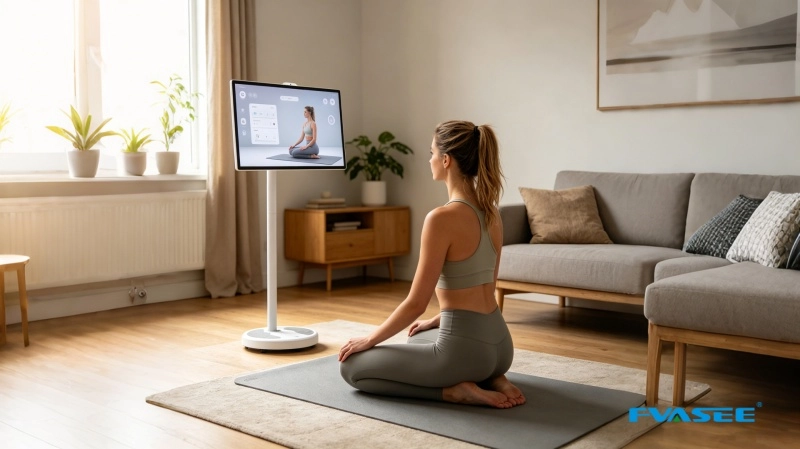
· Display for fitness and yoga sessions with guided workout apps.
· Display for gaming with cloud gaming platforms or Android games.
· Display for family communication through messaging and video calls.
· Display for elderly care, allowing caregivers to stay connected with family members.
· Display for smart home control, integrating lighting, cameras, and home automation devices.
A rolling smart TV or smart TV on wheels fits naturally into these changing routines because it removes the limitations of fixed installation. Consumers appreciate products that support their lifestyle without requiring additional equipment in every room.
This multi-scenario approach also creates more opportunities for retailers. Rather than marketing a device solely as a television, many brands position it as a flexible digital companion for modern homes.
What Should OEM Buyers Look for Beyond Product Specifications?
Specifications such as processor performance, screen resolution, or memory capacity are easy to compare. They are also easy for competitors to match.
For distributors, private-label brands, and retailers, long-term success depends on evaluating the manufacturer behind the product as carefully as the product itself.
Important considerations include:
· Stable production capacity.
· Consistent quality control.
· Product certification for target markets.
· Software update capability.
· Industrial design support.
· Custom branding services.
· After-sales technical assistance.
· Supply chain reliability.
Many purchasing teams initially focus on pricing. Over time, they often realize that delays, inconsistent quality, or limited engineering support create higher costs than the initial purchase price.
For companies planning a custom portable smart TV or private label smart display, choosing an experienced manufacturing partner can reduce development risks while shortening time to market.
Why Manufacturing Experience Matters in a Fast-Growing Category
The portable display market continues to evolve rapidly. Screen technology, battery performance, wireless connectivity, and AI functions are improving with every product generation.
Manufacturers need more than assembly capabilities. They require experience integrating multiple technologies into reliable consumer products.
Strong manufacturers generally demonstrate strengths in several areas.
Evaluation Factor | Why It Matters |
Product engineering | Improves stability and long-term reliability |
Industrial design | Enhances user experience and product appeal |
Software integration | Supports Android updates and application compatibility |
Quality management | Reduces product defects and warranty claims |
Global certifications | Simplifies entry into international markets |
OEM & ODM capability | Supports customized product development |
Supply chain management | Maintains stable delivery schedules |
Another important factor is product scalability. Brands often begin with one model before expanding into multiple screen sizes or feature combinations.
A manufacturer capable of supporting product upgrades, customized hardware, and software optimization offers greater flexibility as market demand changes.
How Fvasee Supports Portable Smart Display Development
As the market for portable smart display solutions expands, many brands are looking for manufacturing partners that can support both standard products and customized projects.
Fvasee focuses on developing smart display solutions for consumer and commercial applications, combining hardware development, software integration, and manufacturing resources within one production system.
Its product portfolio covers a variety of display categories, including:
· Portable Smart TV
· Portable Smart Display
· Android Smart Display
· Interactive Smart Screen
· Commercial Display
· Digital Signage
· Touch Screen Display
For OEM and ODM customers, flexibility is often as important as product performance. Depending on project requirements, customization may include:
· Screen size selection.
· Android platform configuration.
· Memory and storage options.
· Camera integration.
· Battery capacity.
· Housing color and industrial design.
· Logo customization.
· Packaging and documentation.
This combination allows distributors, retailers, and consumer electronics brands to develop products aligned with their own market positioning instead of relying entirely on standardized models.
As consumer expectations continue shifting toward connected and mobile devices, manufacturers that invest in product innovation and long-term engineering support are better positioned to respond to future market demands.
Consumer expectations for display devices have changed considerably over the past few years. A screen is no longer viewed simply as a television for watching movies. Buyers increasingly expect one device to support entertainment, communication, productivity, learning, fitness, and smart home interaction.
This shift explains the growing popularity of the portable smart display. Features such as battery operation, Android compatibility, touch interaction, integrated cameras, and wireless connectivity allow a single display to serve multiple roles throughout the day. The result is a product category that fits modern lifestyles more naturally than many traditional televisions.
For distributors, retailers, and OEM brands, market opportunities extend beyond introducing another display product. Success depends on understanding how consumers actually use these devices and selecting manufacturing partners capable of delivering reliable hardware, flexible customization, and consistent product quality.
Fvasee continues to develop portable smart TV, portable smart display, and Android smart display solutions designed for evolving consumer needs. By combining manufacturing experience with OEM and ODM capabilities, the company supports brands seeking adaptable display products for both current demand and future market opportunities.
As connected homes, AI-enabled devices, and wireless entertainment ecosystems continue to expand, portable smart displays are likely to become an increasingly familiar part of everyday life—not as a replacement for traditional televisions, but as a practical extension of how people work, communicate, and enjoy digital content.