 English
 Italian
 Spanish
 Turkish
 Portuguese
 Dutch
Dutch Korean
 Russian
 French
 German
 Polish
 Arabic
 Hindi
HindiHow Does a Battery Powered Smart TV Fit Into Spaces Without Fixed TV Installation?
A television normally starts with a fixed point: a wall socket, a mounting position, a cable route, and a place where people are expected to sit.
That arrangement works well until the room changes.
A meeting area may be rearranged for a different event. A showroom may need to change its product layout. An exhibition booth may have limited access to power. A hotel may want to use the same display in different parts of a room or event area.
In these situations, the challenge is not simply moving the television. The bigger issue is avoiding a setup that depends on one permanent installation point.
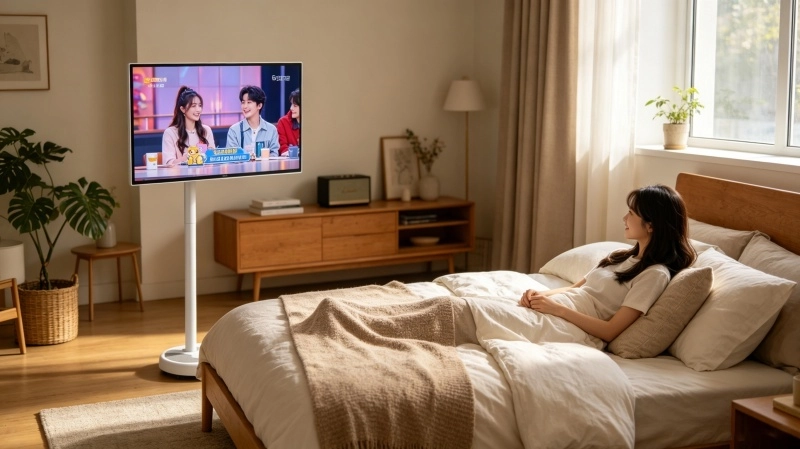
A battery powered smart TV offers another approach. Combined with Wi-Fi, Bluetooth, a built-in battery, and a freestanding structure, it can support display use in places where permanent TV installation is inconvenient.
Fixed TV Installation Creates More Restrictions Than It First Appears
Installing a conventional television usually involves more than mounting the screen.
The location needs:
· A suitable wall or stand
· A nearby power outlet
· Cable routing
· A mounting bracket
· Enough wall strength
· Space for external devices
· A practical viewing position
Once these elements are in place, changing the television's location can require additional work.
That can be acceptable for a living room or permanent meeting room. It becomes less convenient in spaces where the layout changes regularly.
A portable smart TV removes some of these restrictions by allowing the display to operate away from a permanently installed television point.
The distinction is particularly useful for commercial environments, temporary spaces, and rooms serving several purposes.
Battery Power Changes Where the Display Can Be Used
The built-in battery is one of the most important features when there is no convenient fixed power connection.
Consider an exhibition booth where the preferred display position is several metres away from the nearest power outlet. Running a long cable across a visitor area may create an unattractive setup and may also interfere with movement around the booth.
A portable TV with battery gives the team another option.
The display can be positioned where visitors can actually see it, rather than where the nearest outlet happens to be.
The same principle can apply to:
· Temporary meeting areas
· Training rooms
· Hotel event spaces
· Product demonstrations
· Reception areas
· Showrooms
· Pop-up retail spaces
· Short-term exhibitions
Battery operation does not eliminate the need for charging. It simply separates the viewing position from the fixed location of a wall socket during normal use.
That difference can be valuable when the space has to remain visually clean or when temporary cabling would be inconvenient.
Wireless Connectivity Reduces the Need for Cable-Heavy Setups
Power is only one part of a conventional television installation.
External video sources, network connections, speakers, and other equipment can add more cables around the display.
The FVASEE 32-inch model supports Wi-Fi and Bluetooth, giving users more flexibility when connecting the display to compatible devices and networks.
A wireless smart TV can therefore fit more naturally into spaces where cable management is difficult or where the equipment is expected to move.
For example, a presentation team may need to reposition the display after changing the seating arrangement. A showroom may move the screen closer to a different product area. An event organizer may change the layout between sessions.
Reducing unnecessary cabling makes those changes easier to handle.
There Is a Difference Between Wireless and Completely Cable-Free
It is important not to treat wireless connectivity as a replacement for every physical connection.
Some projects still require HDMI, USB, network cables, charging, or other wired interfaces. External equipment may also have its own connection requirements.
The practical benefit is having a choice.
A fixed television often assumes that the installation will remain unchanged. A portable wireless display allows the project team to decide when a wired connection is necessary and when wireless operation is sufficient.
That flexibility becomes more useful when the display is shared between several rooms or applications.
Small Spaces Benefit From a Smaller Display Footprint
A battery-powered display does not need to be large to be useful.
The 32-inch format sits in a practical middle range for personal viewing and small-group use. It provides a Full HD 1920×1080 display while remaining easier to position than a large commercial screen.
This can be useful in places where floor and wall space are limited.
Hotel rooms
A large fixed television may dominate a smaller room. A 32-inch portable home TV screen can be positioned according to the room's current use.
Small meeting rooms
The screen can be moved closer to the participants when a presentation or discussion begins, then relocated when the room is used for another purpose.
Showrooms
The display can support product demonstrations without permanently occupying one display wall.
Exhibition booths
The compact size makes it easier to incorporate the screen into a temporary booth layout without creating a large visual barrier.
The Display Can Follow the Activity
The strongest case for a movable television is not simply transportation.
It is the ability to follow the activity taking place in the room.
Imagine a hotel event area being used for three different activities on the same day.
In the morning, the display supports a training session.
At lunchtime, the room changes into a reception area.
In the afternoon, another group uses the space for a product presentation.
A fixed display remains in the same position throughout the day. A portable unit can be repositioned according to the current activity.
The 32-inch FVASEE model adds another layer of adjustment through its 180-degree screen rotation, 45-degree tilt range, and 20cm height adjustment.
The result is not simply a screen that moves from Point A to Point B. The display can be repositioned and then adjusted for the new viewing conditions.
Battery Operation Also Makes Temporary Installations Easier
Permanent installation makes sense when the same equipment will remain in the same place for years.
Temporary installations are different.
An event may last several days. A showroom may change its layout every few weeks. A company may need an additional display during a training period but have no reason to install another permanent screen.
A battery powered TV can fill this type of requirement without turning every temporary display need into a construction project.
There is no need to treat every new viewing position as a new installation point.
This can also simplify equipment storage. When the display is no longer needed in one area, it can be moved to another suitable location instead of remaining attached to an unused wall.
Where a Battery Powered Smart TV Makes Particular Sense
The technology is most useful when several conditions appear together:
The display location changes.
Permanent installation is unnecessary.
Power access is limited or inconvenient.
The room has more than one use.
The display needs to be moved between activities.
When those conditions exist, a battery-powered design becomes more than a convenience feature.
Hotels and hospitality
Guest rooms, meeting areas, lounges, and event spaces can have different layouts and viewing requirements.
Corporate offices
Meeting rooms and training areas may be rearranged depending on the number of participants and the type of session.
Retail and showroom environments
Product displays change frequently. A screen that can move with the merchandise layout can be easier to manage than a permanently installed television.
Events and exhibitions
Temporary installations often need to be assembled quickly and removed just as easily.
Education and training
A display can be positioned according to the classroom or training-room arrangement rather than being restricted to one wall.
What Buyers Should Check Before Choosing a Battery Powered Model
Battery operation is useful, but it should not be the only purchasing consideration.
For a battery powered smart display, buyers should check the complete configuration.
Battery and operating requirements
Confirm battery capacity, expected operating conditions, charging method, and charging time according to the intended usage pattern.
Display quality
The 32-inch FVASEE model uses a 1920×1080P LCD panel. Buyers should match resolution and screen size with the viewing distance and content type.
Adjustment range
Check whether the screen can rotate, tilt, and change height enough for the intended environment.
Wireless functions
Confirm Wi-Fi and Bluetooth support according to the devices and applications that will be connected.
Mobility
Universal wheels can make repositioning easier, but the base should also remain stable during use.
Operating system
For projects that need applications beyond standard TV functions, the Android platform and hardware configuration should be checked against the required software.
A Better Fit for Spaces That Refuse to Stay the Same
Fixed television installation remains practical when the room has one stable layout and one permanent viewing position.
That assumption does not apply everywhere.
Hotels change room functions. Offices rearrange meeting areas. Retail stores update displays. Exhibition booths disappear after a few days. Training spaces may serve different groups throughout the week.
A portable smart TV with battery gives these environments another option. Wi-Fi and Bluetooth reduce dependence on fixed connections, while the 32-inch format keeps the display manageable in smaller spaces.
Add the rotating screen, tilt adjustment, height adjustment, and universal wheels, and the product becomes a flexible display platform rather than a television tied to one installation point.
For distributors, hospitality projects, commercial buyers, and other professional users, this creates a useful product category between a conventional fixed TV and a large commercial display. A portable smart TV manufacturer can also adapt the configuration for specific market requirements through OEM and ODM production.