 English
 Italian
 Spanish
 Turkish
 Portuguese
 Dutch
Dutch Korean
 Russian
 French
 German
 Polish
 Arabic
 Hindi
HindiWhen Is a 32 Inch Portable Smart TV More Practical for Flexible Viewing?
A television does not always need to face the same sofa, stay at the same height, or remain in one position throughout the day.
In a meeting room, the screen may need to face a group sitting around a table. In a hotel room, the viewing position can change between the bed, sofa, and desk. At an exhibition or showroom, visitors may approach from different directions. Even in an office, the same screen may be used for a presentation in the morning and moved toward another working area in the afternoon.
These situations put more emphasis on viewing flexibility than on simply having a large screen.
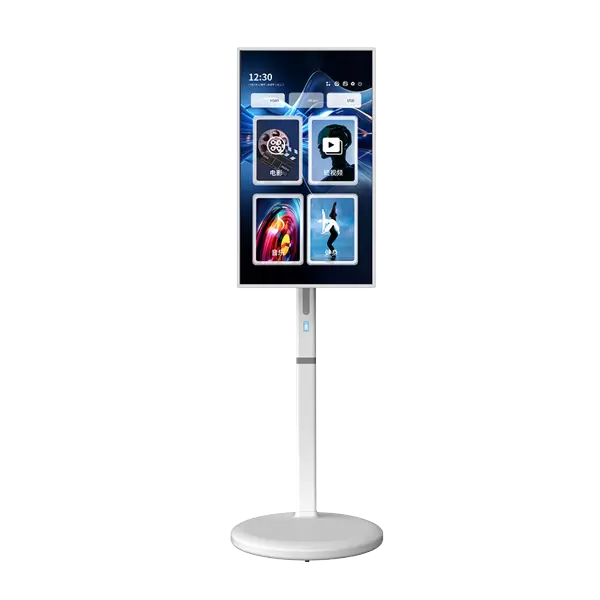
The 32-inch Portable Smart TV from FVASEE combines a 1920×1080P LCD display with 180-degree rotation, 45-degree tilt adjustment, 20cm height adjustment, universal wheels, Wi-Fi, Bluetooth, and a built-in battery. The result is closer to a flexible display device than a conventional television that happens to have wheels.
The Useful Part Is Not the Wheel. It Is the Position of the Screen.
It is easy to describe a product like this as a portable smart TV because it can be moved around. That description only covers one part of the design.
The more interesting question is what happens after the display reaches its new position.
A fixed television normally gives the user one viewing direction. Change the seating arrangement and the screen may no longer be positioned correctly. Move a meeting table, change the layout of a showroom, or rearrange a hotel room, and the original installation position may become inconvenient.
The FVASEE 32-inch model approaches the problem differently.
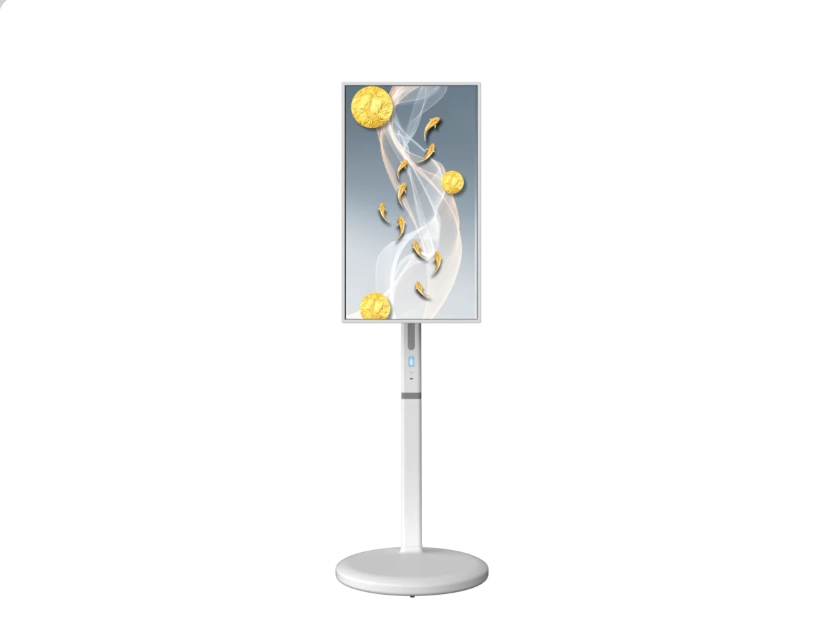
The screen can rotate up to 180 degrees, while the display angle can be adjusted through a 45-degree range. Height can also be changed by 20cm.
That combination allows the screen itself to adapt to the viewing position.
For a portable display with stand, this kind of adjustment can be more useful than simply adding a larger panel. The screen does not have to dominate the room. It can be positioned according to where people are actually sitting or standing.
180° Rotation Changes the Viewing Direction
Imagine a small meeting room where six people are sitting around a table.
The display starts facing one side of the room. Later, the meeting changes into a discussion involving people sitting in another direction. With a fixed display, the furniture has to adapt to the screen. With a rotating screen smart display, the screen can be repositioned instead.
The 180-degree rotation is particularly useful in spaces where the viewing direction changes during the day.
Meeting and training spaces
A presentation may be viewed from one side of the room, while a training session uses a different seating arrangement.
Hotel rooms
Guests may watch from the bed, sofa, or another position without needing a television permanently fixed to one wall.
Showrooms
Visitors do not always approach a product from the same direction. The display can be turned toward a new viewing area when the layout changes.
Exhibitions
Booth layouts often need to be adjusted according to visitor flow. A portable smart viewing screen can be repositioned without redesigning the entire display area.
The important point is that rotation is not simply a mechanical feature. It changes the relationship between the display and the people using it.
Tilt and Height Adjustment Solve a Different Problem
Rotation controls direction. Tilt and height control viewing comfort.
The 32-inch model supports a 45-degree tilt range, including 25 degrees of elevation and 20 degrees of depression. It also provides 20cm of height adjustment.
That gives the display several practical positions.
Viewing situation | Useful adjustment |
Seated at a desk | Lower the screen and adjust the viewing angle |
Standing presentation | Raise the screen for a more natural sightline |
Sofa or lounge seating | Tilt the screen toward the viewer |
Small group discussion | Rotate and angle the screen toward the group |
Exhibition or showroom | Adjust height according to visitor position |
This makes the product different from a conventional portable TV monitor with a fixed viewing position.
A screen that can only move from one place to another is mobile. A screen that can also change its direction, height, and angle is much more adaptable.
Why 32 Inches Can Make Sense
Bigger is not automatically better for every viewing environment.
A 32-inch display occupies considerably less visual and physical space than a large commercial display. That matters in rooms where people need to move around the screen rather than gather in front of it.
The 1920×1080P resolution provides a practical Full HD format for everyday video, presentations, information content, streaming, and other visual material.
For one person or a small group, the viewing distance is often moderate. A larger screen can introduce unnecessary size without solving the actual problem.
This is where a 32 inch portable smart TV can fit between a conventional television and a larger commercial display.
It provides enough screen area for shared viewing while remaining manageable when the room layout changes.
Wireless Operation Makes More Sense When the Room Changes
The built-in battery is another part of the flexible-use concept.
A traditional television normally assumes a fixed power location. The furniture, cable routing, and installation position are planned around that assumption.
A battery powered smart TV changes the sequence.
The display can be positioned first according to the viewing requirement, with power availability becoming less restrictive during use.
Wi-Fi and Bluetooth add another layer of flexibility. Wireless connectivity can reduce the number of cables needed around the display and make the device easier to use in spaces where permanent wiring is undesirable.
This does not mean every application should operate completely wirelessly. External devices, charging, and network requirements still need to be considered. The practical advantage comes from having more options when the installation does not follow a fixed layout.
The Same Display Can Serve Different Parts of a Space
One of the stronger use cases for a movable smart TV is a space that does not have one permanent function.
Consider a small hotel conference area.
In the morning, the display can face a training group. Later, it can be turned toward another seating area for a presentation. During an evening event, the same screen can be repositioned for video playback.
The display does not need to be purchased, installed, and configured separately for every activity.
A similar situation can occur in:
· Small offices
· Hotel meeting rooms
· Training centers
· Showrooms
· Retail demonstration areas
· Exhibition booths
· Reception areas
· Temporary event spaces
This is also where the concept of a multi scenario smart display becomes relevant. The value comes from adapting one display to several real operating conditions rather than assigning the device to only one permanent position.
A Portable Smart TV Is Not the Same as a Fixed TV With Wheels
The distinction becomes clearer when the complete structure is considered.
A basic smart TV on wheels mainly solves transportation. The user can push the television from one place to another, but the viewing angle and height may remain relatively limited.
The FVASEE design combines several adjustments:
Move → Rotate → Tilt → Raise or Lower → Connect Wirelessly
Each action addresses a different part of the viewing environment.
The wheels handle relocation.
The 180-degree mechanism handles direction.
The tilt mechanism handles viewing angle.
The 20cm height adjustment handles viewing position.
Wi-Fi and Bluetooth reduce dependence on fixed connections.
That combination gives the product a broader role than a conventional movable television.
Where This Type of Display Fits Best
The strongest application is not necessarily a specific industry. It is a specific type of space.
The common factor is change.
If the furniture moves, the screen can move.
If the audience changes direction, the screen can rotate.
If users change from sitting to standing, the height and angle can be adjusted.
If the display needs to be used away from a fixed television point, battery operation provides another option.
That makes the product particularly relevant to spaces where permanent installation would be unnecessarily restrictive.
For distributors and project buyers, the same characteristics also create opportunities beyond standard consumer television. A portable smart TV manufacturer can adapt this type of product for hospitality, commercial display, showroom, event, and other flexible-use requirements.
FVASEE can also support OEM and ODM requirements when a project needs changes to the appearance, branding, configuration, or other product details.
The Better Question Is Where the Screen Needs to Be Tomorrow
The practical value of a 32-inch portable smart TV becomes clearer when the question changes from “Where should the TV be installed?” to “Where will the screen need to be used next?”
If the answer is always the same location, a conventional fixed television may be sufficient.
If the answer changes with the room, the audience, the activity, or the layout, mobility alone is not enough. The screen needs to change with the environment.
That is where the combination of 180-degree rotation, 45-degree tilt, 20cm height adjustment, battery-powered operation, Wi-Fi, and a compact 32-inch Full HD display becomes useful.
The product is not designed around one fixed viewing position. It is designed for spaces where the viewing position keeps changing.