 English
 Italian
 Spanish
 Turkish
 Portuguese
 Dutch
Dutch Korean
 Russian
 French
 German
 Polish
 Arabic
 Hindi
HindiWhat Makes a Touch Display Easy for First-Time Users?
Walk up to a public touch display and the first few seconds usually tell you everything. If the main options are clear, the next step is easy to find, and the screen responds as expected, most people start using it without asking for help. When the interface is crowded or the navigation feels unfamiliar, even a technically capable display can end up being ignored.
First-time use matters in reception areas, shopping centers, exhibition halls, schools, hotels, hospitals, and corporate buildings because many visitors will never receive instructions before using the screen. The interface has to communicate its purpose through the screen itself.
For businesses deploying a wall mounted touch screen display, usability should therefore be considered alongside screen size, operating system, and hardware configuration.
The First Screen Should Tell People Where to Start
The opening page has one job: give users a clear starting point.
A visitor directory may present options such as Find a Company, View Floor Map, or Search Services. A retail display may begin with product categories, promotions, or a search function. A company reception display may offer visitor registration and basic corporate information.
Problems usually appear when everything is placed on the first screen.
Ten or fifteen buttons may technically provide more functions, but users have to spend more time deciding which one to press. The main functions should have stronger visual priority, while less frequently used information can sit behind secondary menus.
For an interactive wall display, simplicity at the first step can make a bigger difference than adding another feature to the system.
Use Familiar Words Instead of Internal Terminology
Visitors do not necessarily know how a company organizes its information.
An equipment manufacturer may divide products according to internal model numbers, product families, or technical categories. A customer may simply want to find “industrial pumps” or “replacement parts.”
The same issue appears in corporate directories. Internal department names may make perfect sense to employees but mean little to an outside visitor.
Labels on an interactive touch screen display should therefore reflect the language users are likely to recognize.
Short labels also work better than long sentences. Product Search is easier to scan than Please Select the Product Category You Would Like to View.
Small changes in wording can reduce unnecessary hesitation.

Keep the Number of Steps Under Control
People using a public display usually have a specific task in mind.
They may want to locate a shop, check a product specification, find a meeting room, or register for an appointment. They do not necessarily want to browse every page available in the system.
A useful navigation path might look like:
Category → Selection → Details → Action
For a retail application:
Product Type → Product Model → Specifications → Inquiry
For a building directory:
Building → Floor → Department → Location
Longer navigation paths are sometimes unavoidable, especially for systems with large databases. The important part is giving users a clear indication of where they are and how to return to the previous level.
A visible home or back function can prevent users from becoming trapped inside a menu.
Touch Buttons Need Enough Space
Touch interaction is different from using a mouse.
Small buttons positioned close together can be difficult to operate, particularly when the display is being used by older visitors, children, or people who are unfamiliar with the interface.
Controls that perform important actions should have enough visual and physical separation. Search, confirmation, back, home, and navigation functions deserve particular attention.
The problem becomes more noticeable in busy public spaces. Someone may be standing at an angle rather than directly in front of the screen, while another person waits nearby.
A commercial touch screen should accommodate those conditions rather than being designed only for perfect indoor testing.
Make Important Information Easy to Read
Text size needs to match the viewing distance.
A 65-inch wall mounted touch screen display may be viewed from several meters away in a training room or exhibition area. A smaller display installed near a reception counter may be used from a much shorter distance.
Content should be tested at the actual installation distance.
Product descriptions, prices, directions, room numbers, and key instructions should remain readable without forcing users to move closer to the panel.
Visual hierarchy also helps. Large headings can identify the current section, while supporting information can use a smaller scale.
Good layout often allows users to understand the page before reading every word.
Don't Make Every Interaction Look Different
Consistency reduces the amount of thinking required from the user.
If the back button appears in the upper-left corner on one page and moves to the lower-right corner on another, users have to search for it again.
The same principle applies to icons, colors, menu positions, confirmation buttons, and page transitions.
Once users understand one section of an interactive wall display, the following screens should behave in a familiar way.
Consistent design becomes especially important for applications with many pages. Product catalogs, directories, and service platforms can contain hundreds of information points, so users benefit from predictable navigation.
Consider Users Who Are Not Comfortable With Technology
A public touch screen should not assume technical experience.
Some users may be comfortable navigating apps every day. Others may rarely interact with digital interfaces.
The screen should make basic actions obvious without requiring a manual.
Simple instructions can help when a task needs clarification. For example, a search page may show a short prompt such as Enter Product Name rather than leaving an empty search box without explanation.
Confirmation messages also matter. After a visitor submits a request or completes a registration process, the system should clearly indicate that the action has been completed.
Uncertainty often causes users to press the same button repeatedly.
Screen Position Affects Usability
Good interface design cannot compensate for an inconvenient installation position.
A wall mounted touch screen display placed too high may be uncomfortable for shorter users. A panel installed where sunlight falls directly across the screen can also make content harder to see.
Project teams should consider:
· Average user height
· Viewing distance
· Approach direction
· Available wall space
· Lighting conditions
· Nearby furniture or obstacles
· Cable access
The physical environment and digital interface need to work together.
Design for the Person Using the Screen and the People Watching
Interactive displays are often used by more than one person.
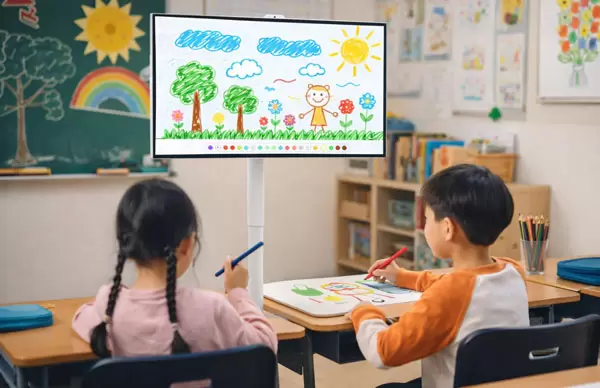
In a classroom, one student or teacher may operate the display while others watch. In a showroom, one customer may browse products while another person stands beside them.
The person touching the panel needs clear controls, while people standing farther away need readable information.
Larger headings, clear images, and uncluttered layouts help both groups.
FVASEE's wall mounted touch screen display range includes 42/43-inch, 49/50-inch, 55-inch, and 65-inch models, allowing projects to match screen size with the expected viewing environment.
Hardware Still Matters
User experience does not come entirely from software.
Display resolution, brightness, touch response, operating system, processor configuration, and available interfaces can all affect the final application.
FVASEE provides Android and Windows configurations for its wall mounted interactive display products, allowing the hardware environment to be matched with different applications.
For a project intended for first-time users, the sample unit should be tested with the actual content rather than evaluated only from a specification sheet.
Watch how quickly a new user can complete a task. Notice where they hesitate. Check whether buttons are easy to find and whether the text remains readable from the normal viewing position.
Those observations can reveal problems that a technical datasheet cannot.
A Simple Test Before Mass Deployment
Before installing multiple interactive touch screen displays, ask several people who have not seen the interface before to complete a few basic tasks.
For example:
· Find a specific product.
· Locate a department.
· Return to the home page.
· Check a specification.
· Complete a simple inquiry.
Do not explain the navigation beforehand.
Watch where users stop, what they press first, and whether they need assistance.
For B2B projects, this type of testing is useful because the same interface may be deployed across dozens of displays. Fixing a confusing navigation step during the sample stage is much easier than changing it after installation.
The easiest touch display to use is rarely the one with the largest number of functions. Clear navigation, readable content, predictable controls, and a sensible physical installation give users enough confidence to start interacting without being told what to do.
SEO Title
What Makes a Touch Display Easy for First-Time Users?
Meta Description
See what makes a wall mounted touch screen display easier for first-time users, from interface layout and navigation to touch controls, readability, and installation.
Article Introduction
Public touch displays often serve people who have never used the system before. Clear navigation, readable information, comfortable touch controls, and familiar interface patterns can determine whether visitors use the screen smoothly or give up after a few seconds. This article looks at the practical design and hardware factors that make interactive wall displays easier for first-time users.
How Can Wall Mounted Touch Displays Be Used in Retail Stores?
Walk into a large retail store and the customer journey does not always begin with a conversation with a salesperson. Some shoppers already know what they want. Others are comparing models, checking specifications, looking for another product size, or simply trying to find the right department.
Wall mounted touch displays can support these different situations without replacing the store's existing sales process. They can provide product information, guide customers through categories, support self-service searches, and give brands another way to present products inside a physical location.
For retailers, the value comes from fitting the display into the existing customer journey rather than treating it as another advertising screen.
Product Browsing at the Point of Sale
Product information can become difficult to manage when a store carries many models.
Physical shelves have limited space. Only selected products can be placed in front of customers, while additional colors, sizes, configurations, accessories, or related products may remain elsewhere.
A wall mounted touch screen display can provide access to that additional information.
A customer could choose:
Product Category → Model → Color or Size → Specifications → Related Products
Product images can be combined with descriptions, technical information, videos, and other content.
The customer gets more information without requiring every product variation to occupy physical shelf space.
Product Comparison Can Help Customers Narrow Their Choice
Comparison is particularly useful for products with several similar models.
A customer may want to compare screen size, storage capacity, features, dimensions, or other specifications before making a purchase.
A traditional poster usually presents one fixed message. An interactive touch screen display can let the customer choose which products to compare.
For technical products, the difference can be significant.
Instead of asking a salesperson to explain several models from memory, customers can review the same standardized information on the screen.
Sales staff can then spend more time discussing requirements, installation, pricing, or other parts of the purchasing decision.
Digital Product Catalogs Extend the Store's Physical Inventory
Retail space is expensive, and floor space cannot expand every time a product range grows.
Digital catalogs provide another option.
Products that are not currently displayed can still appear on an interactive wall display. Customers can browse categories and view models that may be available for order.
This approach can work particularly well for:
· Furniture
· Appliances
· Consumer electronics
· Building materials
· Home improvement products
· Automotive products
· Specialized equipment
The screen does not need to replace physical products. It can fill the information gap between what the customer sees on the floor and what the retailer can actually supply.
Store Navigation Can Become Part of the Display
Large stores often contain multiple departments.
Customers may know what they want but not where to find it.
An interactive store directory can provide a map, department information, product categories, and directions from the current location.
The same display can also promote selected products or current offers without interrupting the navigation function.
Content needs to be organized carefully here. Navigation should remain easy to find, while promotional content should not dominate the interface to the point where customers cannot locate the information they came for.
Promotions Can Become Interactive
Traditional promotional signage delivers one message to everyone.
Touch interaction allows customers to decide what they want to see.
A promotion page could provide:
· Product details
· Available colors
· Special offers
· Related products
· Usage videos
· Accessories
· Store availability
· Contact or inquiry options
For a customer already interested in a product, the ability to access additional information can be more useful than watching another promotional video.
The same screen can therefore support both brand communication and product research.
Retail Displays Need to Work During Busy Hours
Retail environments are rarely quiet.
People walk past the screen, stand at different angles, interact while carrying shopping bags, and may share the screen with another customer.
A commercial touch screen needs an interface that remains easy to operate under those conditions.
Large touch targets, short navigation paths, clear product categories, and readable text are particularly important.
The physical installation also deserves attention. Wall mounting can keep the display out of the way of shopping traffic while maintaining a fixed position for customers.
Screen Size Should Follow the Store Environment
Retail applications do not all need the same display size.
A compact product information point may work with a 42/43-inch display. A larger product catalog or comparison interface may benefit from a 49/50-inch or 55-inch screen. A display intended for group viewing in a showroom or large retail area may require 65 inches.
The decision should consider more than the physical wall.
Look at:
· Typical viewing distance
· Number of users
· Amount of product information
· Available wall space
· Interface complexity
· Whether customers will interact individually or in groups
FVASEE offers 42/43-inch, 49/50-inch, 55-inch, and 65-inch wall mounted touch screen display options, giving retailers room to match the display with different store layouts.
Connect the Display With the Retail Application
A retail touch screen becomes more useful when the content reflects actual store information.
Product details, inventory status, prices, promotions, and other information may come from an existing retail system.
The display therefore needs to work with the software environment used by the retailer.
Android and Windows configurations can serve different application requirements, depending on the software platform and system architecture.
Before placing a larger order, retailers should test the actual application on the proposed display. Checking only the screen resolution or touch function does not confirm that the complete retail workflow will operate properly.
The Display Should Support Staff Rather Than Compete With Them
Interactive retail displays are not necessarily intended to replace salespeople.
The two can serve different parts of the customer journey.
Customers who prefer to browse independently can use the display to gather basic information. Sales staff can step in when a customer needs advice, product recommendations, pricing information, or help with a more complicated purchase.
The display can also reduce repetitive questions.
If customers can check basic specifications, product availability, or store locations themselves, employees can spend more time on conversations that require human assistance.
That makes the technology part of the store's workflow rather than an isolated digital feature.
Keep the Interface Focused on Retail Tasks
Retail screens can easily become overloaded with banners, videos, product images, specifications, promotions, and navigation options.
More content does not necessarily create a better shopping experience.
The interface should guide customers toward the information they need.
For example:
Choose Category → Browse Products → Compare → View Details → Contact or Purchase
The exact path depends on the retailer, but the principle remains the same: each page should have a clear purpose.
Product images should help recognition. Specifications should support comparison. Promotional content should support the buying process rather than interrupt it.
Plan the Display Around the Store, Not Just the Product
The most useful retail touch displays are usually integrated into specific parts of the store.
Near an entrance, the screen may work as a directory or promotional point.
Inside a product area, it may function as a digital catalog.
In a showroom, it may support detailed product demonstrations.
Near customer service, it may provide self-service information or appointment functions.
Each position creates a different user requirement.
For retailers planning several interactive displays, it can therefore make sense to use different content layouts or even different screen sizes rather than installing identical configurations everywhere.
Wall mounted touch displays have a useful role in retail because they connect physical products with digital information. Customers can see the products around them, access additional details on demand, compare options, and continue the purchasing process without depending entirely on printed material or immediate assistance from staff.
FVASEE's wall mounted interactive display solutions can be configured for different commercial requirements, including screen size, operating system, touch technology, and content presentation.