 English
 Italian
 Spanish
 Turkish
 Portuguese
 Dutch
 Korean
 Russian
 French
 German
 Polish
 Arabic
 Hindi
How to Choose a Portable Smart Display Manufacturer?
The global market for portable smart displays is creating opportunities for electronics distributors, retailers, importers, and private-label brands. As demand grows for flexible screens that combine smart entertainment, mobility, and interactive functions, choosing the right portable smart display manufacturer has become an important business decision. The right manufacturing partner can help you develop a product that fits your target market, maintain consistent quality, and build a stable supply chain.
However, comparing manufacturers involves more than checking product photos and unit prices. Buyers need to evaluate engineering capabilities, hardware and software options, OEM/ODM services, quality management, production capacity, and after-sales support. A supplier may offer an attractive quotation but still lack the technical resources or production processes required for a long-term project.
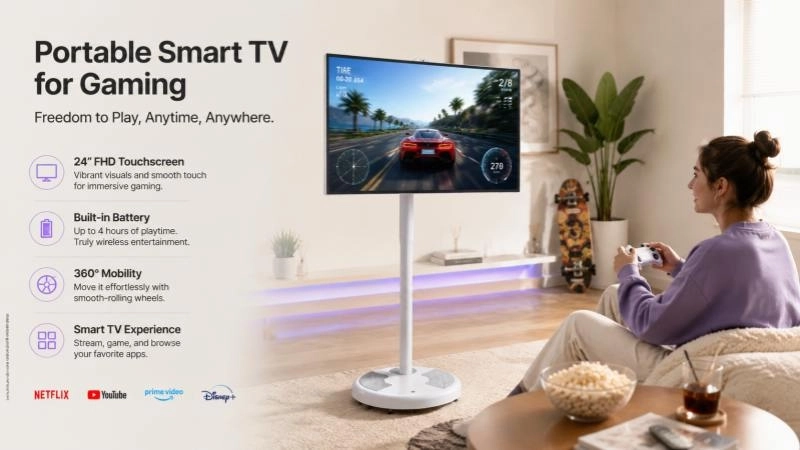
This guide explains how to evaluate a portable smart display manufacturer step by step, from defining your product requirements to confirming samples and preparing for mass production. If you are exploring product options, you can also browse the FVASEE Portable Smart TV product range to see examples of available display formats.
Define Your Product Requirements Before Contacting Manufacturers
Before requesting quotations, clarify what you intend to sell and who will use it. A portable smart display designed for home entertainment may require a different configuration from one developed for education, hospitality, retail, or commercial applications.
Starting with a clear product brief helps manufacturers recommend suitable configurations and provide more meaningful quotations.
Identify Your Target Market and Application
Consider the following questions:
Will the product be sold to individual consumers or business customers?
Is it intended for home entertainment, online learning, video calls, or commercial use?
Which screen sizes are suitable for your target market?
Do customers need a built-in battery or a rolling stand?
Is touchscreen functionality essential?
Which operating system and applications are expected?
Will the product be sold under your own brand?
For example, a retailer developing a portable smart TV for home users may prioritize screen quality, smart operating system compatibility, speakers, and a convenient stand. A distributor targeting business customers may place greater emphasis on connectivity, customized software, packaging, and long-term product availability.
Prepare a Preliminary Specification Sheet
You do not need to finalize every technical detail before contacting a manufacturer. However, preparing a preliminary specification sheet will make communication more efficient.
| Specification | Details to Confirm |
|---|---|
| Screen size | Target sizes and acceptable alternatives |
| Resolution | HD, Full HD, 4K, or project-specific requirements |
| Display panel | Panel type, brightness, viewing angle, and refresh rate |
| Operating system | Android version or another required platform |
| Processor and memory | CPU, RAM, and storage configuration |
| Connectivity | Wi-Fi, Bluetooth, HDMI, USB, and other interfaces |
| Battery | Capacity, charging method, and expected operating time |
| Touch function | Touch technology and number of touch points |
| Physical design | Stand, wheels, housing, dimensions, and color |
| Branding | Logo, boot screen, packaging, and product labels |
These details give the manufacturer a starting point for technical evaluation. They also help you compare quotations on a consistent basis rather than comparing products with different configurations.
Evaluate the Manufacturer's R&D and Engineering Capabilities
A professional portable smart display manufacturer should be able to do more than assemble standard components. Engineering capabilities are important when you need customized hardware, software adjustments, structural changes, or a product developed for a specific market.
Hardware Development and Configuration
Ask whether the manufacturer can support the hardware configuration required for your project.
Important areas include:
LCD panel selection and integration
Mainboard and processor configuration
RAM and storage options
Battery system integration
Wi-Fi, Bluetooth, HDMI, USB, and other interfaces
Speaker and microphone integration
Touchscreen technology
Thermal management and structural design
The manufacturer's engineers should be able to explain the technical implications of different configurations. For example, increasing memory or adding hardware modules may affect product cost, power consumption, thermal performance, and production requirements.
A useful question is not simply whether a feature is available, but whether the manufacturer can validate that feature before mass production.
Software and System Integration
Portable smart displays rely on software as well as hardware. Ask the manufacturer about operating system options, firmware management, application compatibility, and customization support.
Depending on the project, you may need:
A specific Android version
Customized boot logos and startup screens
Pre-installed applications
Customized user interfaces
Firmware configuration
OTA update support
Integration with cameras or other optional modules
If your product will be distributed in several countries, confirm whether the proposed software configuration is suitable for your target markets. Application availability, language support, regional requirements, and compatibility should be checked before finalizing the design.
You can review FVASEE's R&D and engineering capabilities for examples of hardware development, software integration, structural design, and prototype testing services.

Check OEM, ODM, and Private Label Services
For importers, distributors, and brands, customization can be a major reason to work directly with a portable smart display OEM supplier.
However, OEM, ODM, and private label services are not exactly the same. You should identify the level of customization your business actually needs.
OEM: Manufacture According to Your Requirements
OEM is suitable when you already have a product design, technical specification, or detailed configuration.
The manufacturer produces the display according to the agreed requirements. Depending on the project, this may include customized hardware, structural components, software settings, branding, and packaging.
OEM can be a suitable option for established brands that have their own product planning and technical requirements.
ODM: Develop a Product with the Manufacturer
ODM is useful when you have a market opportunity or product concept but need engineering support to develop it.
The manufacturer may help with product structure, hardware configuration, software integration, appearance, and sample development. The exact scope depends on the manufacturer's capabilities and the project agreement.
For companies entering the portable smart display market for the first time, ODM can reduce the amount of in-house engineering work required.
Private Label and Branding
Private label projects allow buyers to sell products under their own brand. Depending on the agreement, customization may include:
Brand logo and product identification
Startup logo or user interface
Customized packaging
User manuals and labels
Selected appearance or color options
Before placing an order, confirm which customization items are included in the quotation and which require additional development costs or minimum order quantities.
It is also important to clarify ownership and usage rights for custom designs, software, tooling, and other project-specific materials in the contract.
Examine Product Quality and Quality Control Procedures
Product quality affects customer satisfaction, return rates, warranty costs, and brand reputation. A reliable portable smart display manufacturer should have a defined quality management process covering incoming materials, production, testing, and final inspection.
Ask About Incoming Material Inspection
The display panel, battery, mainboard, touch module, power components, and housing all influence product performance.
Ask how the manufacturer checks incoming materials and whether critical components can be traced to their suppliers or batches.
For customized projects, confirm whether the manufacturer will notify you before changing key components. An unapproved component substitution can affect product performance and make different production batches inconsistent.
Review In-Process and Final Testing
A quality inspection plan should be agreed before mass production. Depending on the product configuration, relevant checks may include:
| Test Area | What to Verify |
|---|---|
| Display | Image quality, brightness, resolution, and screen defects |
| Touchscreen | Accuracy, responsiveness, and multi-touch operation |
| Battery | Charging, power management, and operating performance |
| System | Startup, application operation, and system stability |
| Connectivity | Wi-Fi, Bluetooth, HDMI, and USB functions |
| Audio | Speaker output and microphone operation, if included |
| Structure | Housing, stand stability, wheels, and assembly |
| Packaging | Accessories, protective materials, and shipping condition |
Ask for details about the inspection stages, sampling rules, defect classification, and final acceptance criteria.
A factory's testing claims should be supported by documented procedures or records relevant to the product. For example, if aging tests are part of the process, clarify the test duration, operating conditions, and how failures are recorded.
Approve a Reference Sample
Before mass production, request a sample that reflects the intended production configuration.
Test it under realistic conditions. Check the display, operating system, applications, touch functions, battery, ports, sound, stand, and packaging. If the product will be used with specific applications or accessories, test those as well.
Once approved, keep a signed specification and sample reference. Any later change to components, software, appearance, or accessories should follow an agreed approval process.
Verify Certifications and Compliance for Your Target Market
Certifications and regulatory compliance should be discussed early, especially when importing electronic products into overseas markets.
Requirements vary according to the destination country, product design, wireless functions, power supply, battery configuration, and intended application. Do not assume that one certificate automatically covers every model or market.
Ask the manufacturer to provide relevant documentation and confirm:
Which product models are covered by each certificate or test report?
Is the document issued by an appropriate testing or certification organization?
Does it apply to the current hardware configuration?
Are additional tests required for the destination market?
Can the manufacturer provide supporting technical documents?
Depending on the market and product, buyers may need to review requirements relating to electrical safety, electromagnetic compatibility, radio equipment, restricted substances, and battery transportation.
For example, CE, FCC, and RoHS may be relevant in certain markets or product contexts, but their applicability and required documentation must be checked against the actual product and destination regulations.
A responsible supplier should be able to explain what documentation is available and what still needs to be completed. Avoid relying only on logos displayed on a website or a general statement that products are certified.
Assess Production Capacity and Delivery Reliability
A manufacturer may be able to produce a good sample but still struggle to deliver a large order on schedule. Production capacity and planning are therefore important parts of supplier evaluation.
Understand the Actual Production Capacity
Ask about the production capacity for the specific model you plan to purchase. General factory capacity may include several product categories and should not automatically be treated as the output available for your order.
Useful questions include:
What is the normal monthly output for this model?
How many production lines can support the order?
Are key components available in sufficient quantities?
What is the expected lead time for the first order?
How does the factory handle seasonal demand?
Can it support repeat orders with consistent specifications?
If you plan to expand distribution, discuss how the manufacturer will manage increased order volumes and component availability.
Confirm the Complete Project Timeline
The production timeline should include more than the manufacturing period.
A typical project may involve:
Requirement review and quotation
Technical confirmation
Sample development
Sample testing and approval
Order confirmation and material preparation
Mass production and quality inspection
Packaging and shipment
Ask the supplier to identify the estimated duration of each stage and the conditions that may affect the schedule. For customized products, sample approval and component procurement can have a significant impact on the overall timeline.
A written production schedule gives both parties a clearer reference for project management.
Compare Quotations Beyond the Unit Price
When comparing portable smart TV manufacturers, the lowest quotation is not necessarily the most cost-effective option.
Two quotations may look similar while covering different components, accessories, packaging, testing standards, or customization services.
Make Sure You Are Comparing Equivalent Configurations
Check whether each quotation includes the same:
Screen size and panel specification
Resolution and brightness
Processor, RAM, and storage
Operating system
Battery and charging components
Touchscreen configuration
Stand and other accessories
Branding and packaging
Quality inspection requirements
Also confirm the order quantity, minimum order quantity, sample cost, tooling or development charges, payment terms, and quotation validity.
Calculate the Total Procurement Cost
The full purchasing cost may include product price, customization, packaging, freight, insurance, import duties, local taxes, testing, and after-sales expenses.
A slightly higher factory price may still be commercially reasonable if it includes a more suitable configuration, stronger packaging, or services that would otherwise need to be purchased separately.
For B2B buyers, the objective should be to compare the total cost and expected product value, not just the price per unit.
Evaluate Communication and After-Sales Support
A manufacturing partnership does not end when the goods leave the factory. Technical questions, spare parts, warranty claims, and future product updates may continue throughout the product's commercial life.
Before selecting a supplier, clarify:
Who will manage technical and order communication?
How are product defects reported and evaluated?
What warranty terms apply?
Are spare parts available?
What is the process for replacement or repair?
Can the manufacturer provide manuals and technical documents?
How are firmware or configuration updates handled?
Can the same model or an agreed successor remain available for repeat orders?
For distributors and private-label brands, product continuity is particularly important. If a model changes during the sales cycle, the manufacturer should communicate the changes and explain whether they affect compatibility, accessories, or product performance.
A clear after-sales agreement helps both sides manage expectations and reduces uncertainty when issues arise.
Why Consider FVASEE as Your Portable Smart Display Manufacturing Partner?
When evaluating a portable smart display manufacturer, buyers should look for a combination of product experience, engineering resources, customization support, and a structured manufacturing process.
FVASEE Technology Co., Ltd. presents itself as a smart display manufacturer with experience dating back to 2001. Its product portfolio includes portable smart TVs, interactive flat panels, and digital signage. The company also provides OEM and ODM services for international business customers.
Its public R&D information describes engineering support across hardware development, Android system integration, structural design, and prototype validation. These capabilities are relevant to buyers who need to adjust product configurations or develop a portable smart display for a particular market.
FVASEE's published manufacturing workflow covers requirement alignment, technical confirmation, sample development, production planning, quality control, packaging, logistics, and after-sales support. The company also publishes indicative sample-development and production timelines. Actual schedules and capacity should be confirmed for the selected model and order quantity.
For a product reference, the 32-inch Portable Smart TV page lists one specific configuration, including Full HD resolution, Android 13, Wi-Fi, Bluetooth, HDMI, a built-in lithium-ion battery, and projected capacitive touch. These specifications belong to that listed model and should not be assumed to apply to every size or configuration.
You can also review the FVASEE OEM/ODM case studies to explore examples of its display applications and project experience.
For buyers considering a long-term partnership, the next step is to share the target market, preferred screen size, required functions, branding needs, and estimated order quantity. This gives the engineering and sales teams a clearer basis for evaluating feasibility and preparing a proposal.
A Practical Checklist Before Choosing a Manufacturer
Before confirming a supplier, use the following checklist to compare potential manufacturing partners.
| Evaluation Area | Questions to Ask |
|---|---|
| Product experience | Has the manufacturer produced similar portable smart displays? |
| Engineering | Can it support the required hardware and software configuration? |
| OEM/ODM | Which customization services are available? |
| Samples | Can a production-representative sample be tested and approved? |
| Quality control | Are inspection procedures and acceptance criteria documented? |
| Compliance | Are relevant certificates and test reports available for the target market? |
| Production | Can the factory meet the required quantity and delivery schedule? |
| Pricing | Are quotations based on equivalent specifications and terms? |
| Communication | Is there a clear project contact and approval process? |
| After-sales | Are warranty, spare parts, and technical support defined? |
Do not make the final decision based on one factor alone. A manufacturer that can demonstrate technical competence, transparent communication, stable production processes, and suitable support is more likely to become a dependable business partner.
Final Thoughts: Choose a Manufacturing Partner for Long-Term Growth
Choosing the right portable smart display manufacturer is a strategic decision for distributors, importers, retailers, and private-label brands. A careful evaluation should cover product requirements, R&D capabilities, OEM/ODM services, sample quality, compliance documentation, production capacity, pricing, and after-sales support.
The best supplier is not necessarily the one offering the lowest initial price. It is the partner that can produce a suitable product, maintain agreed specifications, communicate clearly, and support your business as demand develops.
If you are planning a portable smart TV or custom smart display project, contact FVASEE with your product requirements and target order quantity. The team can review your project needs and discuss possible configurations, customization options, and the next steps for sample development.