 English
 Italian
 Spanish
 Turkish
 Portuguese
 Dutch
Dutch Korean
 Russian
 French
 German
 Polish
 Arabic
 Hindi
HindiWhy Outdoor Digital Signage Requires More Than Just a Bright Screen
Outdoor displays have become part of everyday life. Commuters check arrival times at bus stations, shoppers notice promotional campaigns outside retail stores, visitors rely on digital wayfinding systems, and city authorities publish public information through connected display networks. As digital communication replaces printed posters, expectations for reliability continue to rise.
Many organizatons still assume that selecting an outdoor digital signage solution is simply a matter of choosing the highest brightness level. Brightness certainly affects visibility, but it represents only one element of a much larger engineering challenge. Outdoor equipment operates in environments where sunlight, rain, dust, humidity, wind, vibration, and changing temperatures place constant stress on electronic components. Displays that perform well inside a shopping mall may struggle after only a short period outdoors if they are not designed for continuous external operation.
Project contractors, distributors, and system integrators are paying closer attention to long-term operating costs rather than initial purchase prices alone. Downtime, maintenance visits, replacement parts, and remote management capabilities all influence the total value of a deployment.
This article examines the technical and operational factors behind reliable outdoor advertising display systems, explains why environmental protection matters as much as screen performance, and outlines the criteria procurement teams should evaluate before selecting a digital signage manufacturer for transportation, retail, commercial, and smart city projects.
Why Outdoor Environments Create Different Challenges
Commercial displays installed indoors benefit from stable lighting, controlled temperatures, and minimal exposure to moisture or dust. Outdoor installations face a completely different set of operating conditions.
An outdoor LCD display installed at a transportation hub may operate continuously throughout the year without interruption. During summer, internal temperatures can rise rapidly under direct sunlight. Winter conditions may introduce freezing temperatures, condensation, and strong winds. Urban environments expose equipment to pollution, airborne particles, and frequent public interaction.
Each of these factors affects display performance over time.
Common environmental challenges include:
· Direct sunlight throughout the day
· Heavy rain and high humidity
· Dust accumulation around ventilation areas
· Rapid temperature fluctuations
· Continuous 24/7 operation
· Mechanical vibration from nearby traffic
· Public contact and accidental impact
These conditions require much more than a bright screen. They demand an integrated hardware design that protects sensitive components while maintaining stable image quality.
For this reason, professional commercial digital signage products are engineered differently from indoor advertising displays, even when they appear visually similar.
Brightness Alone Does Not Guarantee Outdoor Visibility
Brightness is usually the first specification buyers compare.
Many procurement documents simply request the highest available brightness level, assuming that greater brightness automatically produces better outdoor performance.
In reality, visibility depends on several related factors working together.
For example, an extremely bright display without proper optical bonding or anti-glare treatment may still suffer from reflections that reduce readability during daylight hours. Poor thermal management can also shorten LED lifespan when higher brightness generates additional heat.
Several technical elements influence outdoor viewing performance:
· Display brightness appropriate for installation conditions
· Anti-reflective glass
· Optical bonding technology
· Automatic brightness adjustment
· Wide viewing angles
· High contrast ratio
· Stable color reproduction
These features work together to ensure that content remains readable during different times of the day rather than maximizing brightness under only one set of conditions.
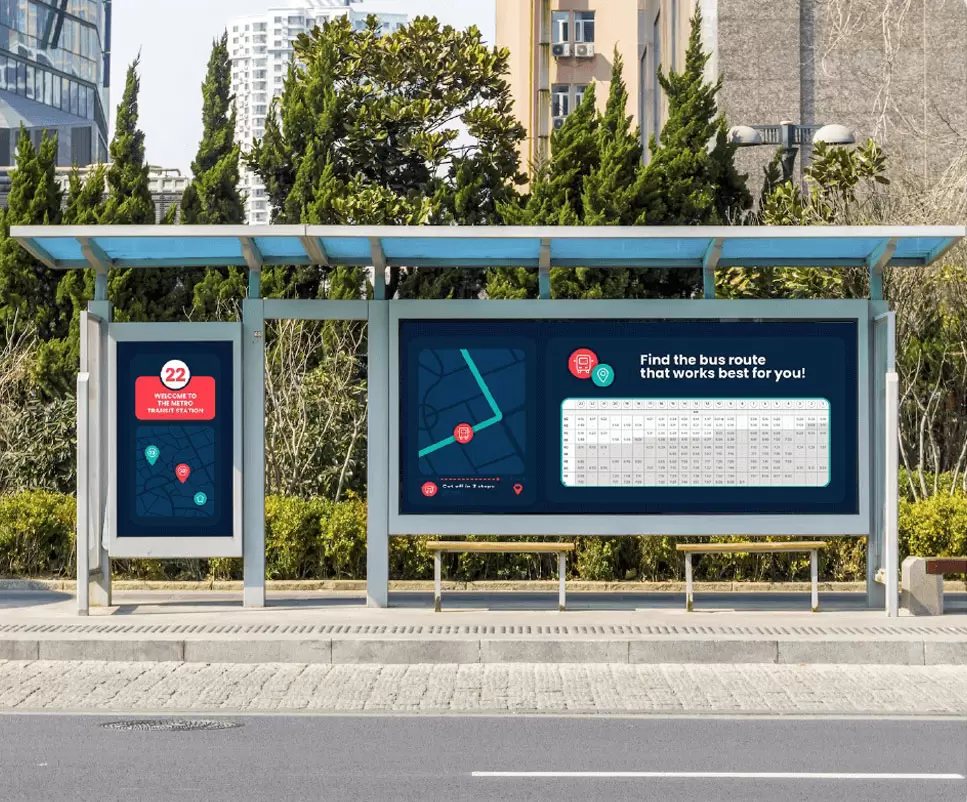
This is particularly important for bus stop digital signage, where passengers often read schedules under changing weather and lighting conditions.
Weather Protection Is a Long-Term Investment
Weather resistance directly affects maintenance costs and equipment lifespan.
Rainwater, airborne dust, and humidity gradually damage electronic systems that lack adequate environmental protection. Even small amounts of moisture entering the enclosure may eventually lead to corrosion, short circuits, or display failure.
A professionally designed weatherproof digital signage system incorporates multiple protective measures instead of relying on a sealed enclosure alone.
Important design considerations include:
· High-quality enclosure sealing
· Industrial cooling systems
· Waterproof cable routing
· Corrosion-resistant metal construction
· Protective surface coatings
· Condensation control
· UV-resistant materials
These engineering details often determine whether equipment continues operating reliably after several years of outdoor exposure.
Procurement teams evaluating total ownership costs increasingly recognize that better environmental protection frequently reduces service expenses throughout the product lifecycle.
Continuous Operation Requires Industrial-Grade Components
Unlike consumer televisions, commercial outdoor displays rarely receive extended downtime.
Advertising campaigns, transportation information, emergency announcements, and public communication systems often operate throughout the day and night.
Continuous operation places significant demands on every internal component.
Critical systems include:
· Industrial power supplies
· Long-life LED backlighting
· Efficient heat dissipation
· Stable processing hardware
· Durable storage devices
· Reliable network communication modules
When any one of these components becomes unstable, the entire display may experience interruptions.
Professional digital signage manufacturers therefore focus on component consistency rather than individual specifications.
A reliable display is built around the ability to deliver predictable performance every day, not simply impressive technical data during initial testing.
Outdoor Digital Signage Applications Continue to Expand
Outdoor displays now serve a much broader purpose than traditional advertising.
Modern cities increasingly integrate digital communication into transportation infrastructure, public services, tourism, education, and commercial developments.
Several industries have adopted outdoor digital signage because information can be updated instantly without replacing printed materials.
Typical deployment scenarios include:
· Bus stations
· Railway terminals
· Airports
· Shopping districts
· Public parks
· Tourist attractions
· University campuses
· Government service centers
· Sports venues
· Commercial office complexes
Each application presents different operational priorities.
A transportation authority may focus on real-time schedule updates.
Retail operators may emphasize promotional flexibility.
Municipal governments often prioritize emergency messaging and public information.
As a result, today's transportation digital signage systems are expected to support multiple content types while remaining available around the clock.
Choosing the Right Display Configuration
Outdoor projects rarely follow a single equipment standard.
Installation methods vary according to available space, viewing distance, pedestrian traffic, and surrounding architecture.
The most common configurations include the following.
Installation Type | Typical Applications | Main Advantages |
Wall Mounted Display | Building entrances, retail storefronts | Space efficient |
Floor Standing Display | Shopping centers, plazas | High visibility |
Bus Shelter Display | Public transportation | Passenger information and advertising |
Double-Sided Display | Streets, commercial districts | Content visible from both directions |
Outdoor Information Kiosk | Parks, campuses, tourist sites | Interactive navigation and public information |
Selecting the correct structure is just as important as choosing display specifications.
A poorly matched installation can reduce visibility, complicate maintenance, or increase operating costs over time.
For larger urban deployments, many contractors also consider future expansion, ensuring that additional displays can be integrated into the same content management platform without requiring major infrastructure changes.
Remote Management Has Become a Standard Requirement
Managing hundreds of outdoor displays individually is no longer practical.
Modern android digital signage platforms allow operators to publish content remotely, schedule advertising campaigns, monitor equipment status, and respond quickly to changing circumstances.
Remote management delivers several operational advantages:
· Centralized content publishing
· Real-time status monitoring
· Scheduled campaign management
· Emergency message broadcasting
· Software updates without on-site visits
· Reduced maintenance costs
For retailers, this means promotional campaigns can be updated simultaneously across multiple locations.
For transportation authorities, service announcements can be distributed immediately throughout an entire network.
For municipalities implementing smart city display solution projects, centralized management significantly improves operational efficiency while reducing labor requirements.
What Procurement Teams Should Evaluate Before Selecting a Digital Signage Manufacturer
Outdoor display projects often involve dozens or even hundreds of units distributed across multiple locations. Once installation is complete, replacing equipment becomes expensive and disruptive. Procurement teams therefore evaluate suppliers based on long-term project performance rather than comparing display specifications alone.
An experienced digital signage manufacturer should be able to explain how its products perform under continuous outdoor operation, how quickly replacement parts can be supplied, and how future system expansion will be supported.
Before requesting quotations, buyers should consider several practical questions.
· Is the display designed specifically for outdoor operation or adapted from an indoor model?
· Can brightness automatically adjust according to ambient lighting?
· Does the enclosure provide adequate protection against rain and dust?
· Is the content management platform stable enough for large deployments?
· Can software updates be completed remotely?
· What is the expected service life under continuous operation?
· Are spare parts available for future maintenance?
· Does the supplier provide OEM or ODM support?
These questions often reveal far more about product quality than comparing specification sheets.
Large infrastructure projects usually remain in service for many years. A supplier with strong engineering capabilities can help reduce operational risks long after installation has been completed.
Why Remote Content Management Has Become a Competitive Advantage
Managing a single display is straightforward.
Managing hundreds of displays across different cities presents an entirely different challenge.
Modern commercial digital signage systems rely heavily on centralized management software that allows operators to update content, monitor equipment, and diagnose faults without visiting each installation site.
Cloud-based management platforms have become particularly valuable for transportation authorities, retail chains, universities, and municipal governments.
Typical remote management functions include:
· Scheduled advertising campaigns
· Emergency information broadcasting
· Real-time equipment monitoring
· Content synchronization across multiple locations
· User permission management
· Device grouping by region
· Playback reports
· Remote software upgrades
For retailers, this means seasonal promotions can be published simultaneously across every branch.
For transportation operators, passenger notices can be updated immediately during service disruptions.
For government departments, emergency announcements can reach multiple public locations within minutes.
These capabilities have transformed android digital signage from a simple advertising platform into an essential communication system.
Outdoor Digital Signage Supports More Than Advertising
Although outdoor displays are often associated with advertising, many installations now perform several functions simultaneously.
A single display may alternate between commercial advertisements, transportation information, weather updates, emergency notifications, and community announcements throughout the day.
This flexibility explains why display solution providers increasingly design systems that support dynamic content management instead of fixed media playback.
Common application scenarios include:
· Public transportation networks
· Shopping malls
· Commercial office districts
· Hospitals
· University campuses
· Tourist attractions
· Sports venues
· Government service centers
· Smart city projects
· Large residential communities
Each environment has different priorities.
Retail operators generally focus on customer engagement.
Transportation authorities prioritize reliable information delivery.
Municipal projects often emphasize public communication and operational efficiency.
The display hardware may appear similar, but software configuration and content management strategies vary considerably depending on the application.
Outdoor Bus Stop Digital Signage Has Unique Requirements
Among all outdoor applications, bus stop digital signage places some of the highest demands on display reliability.
Passengers expect accurate information regardless of weather conditions or time of day.
Displays installed at transportation facilities typically operate continuously while remaining exposed to sunlight, rain, traffic vibration, airborne dust, and temperature changes.
Several characteristics become particularly important.
Requirement | Operational Benefit |
High brightness | Clear visibility under direct sunlight |
Wide viewing angle | Easy reading from different positions |
Industrial cooling | Stable operation during high temperatures |
Weather-resistant enclosure | Reduced maintenance caused by rain and dust |
Remote monitoring | Faster fault detection and maintenance |
Network connectivity | Real-time timetable updates |
Transportation authorities often calculate equipment value based on system availability rather than purchase cost alone.
Displays that experience fewer interruptions contribute to better passenger experiences while lowering maintenance expenses over the entire deployment.
OEM and ODM Capabilities Create Greater Project Flexibility
Standard products meet many project requirements, but larger commercial deployments frequently require customized hardware or software.
This is where OEM and ODM capabilities become valuable.
Experienced advertising display manufacturers can modify equipment according to project specifications without affecting overall reliability.
Typical customization options include:
· Screen size selection
· Brightness configuration
· Android or Windows operating systems
· Housing color customization
· Company logo integration
· Camera modules
· NFC readers
· QR code scanners
· Network communication options
· Installation structures
For distributors, private-label solutions help establish stronger brand recognition.
For system integrators, customized hardware simplifies project deployment while maintaining consistent appearance across multiple installations.
Working directly with a manufacturer capable of supporting customization also shortens communication channels during product development.
Reliability Depends on Manufacturing Quality
Many outdoor displays appear similar when viewed from the front.
The differences become apparent after years of continuous operation.
Long-term reliability depends on manufacturing processes that cannot be evaluated through appearance alone.
Areas that influence product durability include:
· Structural engineering
· Metal fabrication accuracy
· Internal cable management
· Thermal design
· Power supply stability
· LCD panel quality control
· Assembly consistency
· Factory testing procedures
A professional commercial display manufacturer focuses on repeatable production quality rather than producing equipment with the highest specifications on paper.
For distributors managing long-term customer relationships, consistent product performance often matters more than achieving the lowest initial purchase price.
Building Outdoor Display Networks for Smart Cities
Many municipalities are expanding digital infrastructure as part of broader smart city initiatives.
Instead of deploying independent displays for separate departments, cities increasingly build connected communication networks capable of supporting transportation, tourism, emergency services, public information, and commercial advertising from a unified management platform.
These projects commonly integrate:
· Outdoor digital signage
· Information kiosks
· Wayfinding systems
· Interactive displays
· Digital notice boards
· Commercial advertising displays
A centralized approach allows city administrators to publish information efficiently while maximizing the value of existing infrastructure.
For suppliers participating in smart city display solution projects, compatibility, scalability, and long-term technical support become major competitive advantages.
Choosing a Partner for Long-Term Outdoor Display Projects
Selecting outdoor display equipment is rarely a one-time purchasing decision.
Most organizations expect future expansion, additional installation sites, and evolving software requirements.
Choosing a manufacturer capable of supporting those changes reduces future integration challenges.
When evaluating potential suppliers, procurement teams often look beyond hardware performance.
They assess factors such as:
· Manufacturing experience
· Product consistency
· Global project references
· Quality management systems
· Technical support capability
· OEM and ODM experience
· Delivery stability
· Long-term product roadmap
Manufacturers offering a broad portfolio—including outdoor digital signage, bus stop digital signage, outdoor LCD displays, commercial digital signage, and other integrated display solutions—are generally better equipped to support projects as requirements evolve.
Successful outdoor display projects rely on much more than screen brightness. Long-term performance depends on how well the equipment withstands environmental conditions, supports continuous operation, and integrates into an efficient content management system.
From transportation hubs and retail centers to government facilities and smart city developments, today's outdoor digital signage solutions serve as critical communication tools rather than simple advertising screens. Buyers who evaluate weather protection, thermal management, remote management capabilities, manufacturing quality, and lifecycle costs are more likely to achieve dependable performance over many years of operation.
As deployment scales continue to grow, organizations also benefit from working with an experienced digital signage manufacturer capable of providing OEM and ODM services, consistent production quality, and flexible solutions for different industries. Whether the application involves bus stop digital signage, outdoor advertising displays, or broader smart city display solutions, selecting the right technology partner helps create systems that remain reliable, easy to manage, and ready to support future expansion.